Blood on her Tongue by Johanna van Veen
Genre: Historical Fiction
Target Age Group: Teen to young adults
Plot Summary: Blood on her tongue is a psychological thriller that focuses on the fear of change and isolation. It follows the story of Lucy Goedhart as she tries to understand her sister’s strange illness as familial ties and supernatural events work to hinder their progress.
Justification: Blood on her tongue is a 2026 Lambda Literary Award Winner for speculative fiction. I chose this book because I was interested in the darker themes explained in a Goodreads synopsis and it being a Historical Fiction story.
Note: This book contains sexual abuse, sexual content, murder, and body horror. I will do my best to explain why it is a well-written book and why I enjoyed reading it, but it may be helpful to read the story in bursts if the themes presented are uncomfortable to you.

Characters: Each of the characters in the story want something from each other. As she falls deeper into her sickness, Sarah, wants the comfort of her twin sister, Lucy. Before being sick, she is described as being extremely curious and often obsesses over new research or odd discoveries. They are one of the only people that Sarah feels comfortable enough to lower her guard around and tell her secrets to. As the story progresses, Sarah reveals what she truly wants, her sister’s acceptance.
Lucy, the protagonist, wants nothing more than for her sister to get better and is willing to sacrifice anything to ensure that. She dropped everything that she was doing when she received letters that said her condition was getting worse and headed straight to her sister’s home.
Michael, Sarah’s husband, is a man who is used to getting what he wants and usually hides his true intentions and emotions from others. He is unfaithful to his wife (even cheating on Sarah with Lucy), he hates being corrected or criticized by others (especially those he thinks are lesser), and places a great deal of care into his social status. As Sarah’s health gets worse, his main priority is to prevent news of her condition from spreading.
Arthur is a doctor that treats Sarah and is a longtime friend of the main characters, having met them in college. He has a deep curiosity for the latest scientific discoveries and takes a deep fascination to the “bog woman’s” corpse that is found early in the story. He is also in love with Lucy.
Setting: The story is set in the Netherlands near the end of the 1800s. It showcases a male dominated society where women were viewed as being prone to delusions and frantic fits. Meanwhile, the men were seen as the one who could be rational and hold a high social status. This tension gets explored as Lucy tries to explain many of the strange, supernatural events in the story to the other central characters like Arthur, Michael, and the maids but gets discredited as being nonsensical. The men in the story tend to treat her more as a way to relieve their stress than as an intellectual. Though, Lucy is able to piece together the real mystery and confront the main plot of the story through her intuition.
Themes: One of the main themes of the story is the fear of change. Is it more important to hold onto the memory of what someone used to be or to accept what they have changed into? By the time that Lucy is able to see Sarah, she looks malnurished, frail, and sickly. The narrative and some of the other side characters describe her as being akin to a living corpse. Recently, Sarah has been prone to random fits of hysteria where they lash out and attack their caregivers/doctors. Sarah also writes in her letters to Lucy (at the beginning of the story) that she is suffering from severe headaches and nightmares of the bog woman. After a little bit of time, Lucy is able to see that her sister has severely changed both in how she looks and her mental state to the point where she has a hard time recognizing Sarah.
Format: The audiobook helps to carry the emotion and tone of the story. One instance of this was through the audiobook narrator’s chosen accent to help give the story a more authentic setting in the Netherlands. The narrator also did a very good job at acting out the emotions of the characters through the spoken dialogue and Lucy’s internal dialogue.
As a personal note, I prefer listening to audiobooks as they help me stay focused and on track with what I’m reading. When I read, I struggle to find the right pace to help explore the story. In my excitement or interest in reading through the book, I will read through the page as quickly as my eyes can follow and often miss certain details.
Tress of the Emerald Sea by Brandon Sanderson
Genre: Fantasy
Target Age Group: Teen to young adults, 14+
Plot Summary: Tress of the Emerald Sea focuses on an adolescent girl named Tress who goes out on an adventure to save her love from danger. By sailing through dangerous waters and people trying to kill her, how much is she willing to sacrifice in order to achieve her goal?
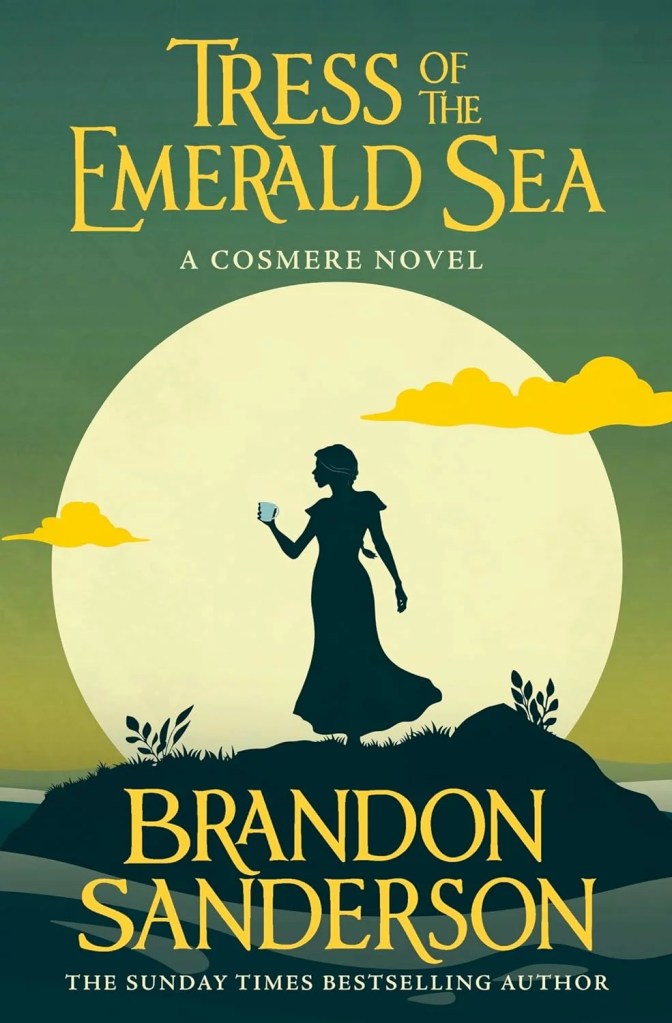
Justification: I chose to read through Tress of the Emerald Sea because a friend recommended that I try reading Brandon Sanderson books and told me that this was a good starting point. In addition, the title and the cover of the book caught my attention as I looked through my library’s online catalogs.
Style and Language:
The story has a self-aware sense of humor with contemporary references. It’s like Douglas’s book called “Hitchhiker’s Guide to the Galaxy.” This is seen through how the narrator explains each scene, revealing character insights through how they choose their diction, sentence structure, and how they rearrange famous sayings.
Characters:
Tress is an observant and somewhat naive sixteen-year-old girl who starts out content just staying home and collecting cups from “around the 12 seas.” She’s reliable and kind, much like her father, and rarely asks for things for herself. However, she’s also incredibly brave when it matters; she eventually decides to leave her home island, cross the Crimson Sea, and save Charlie. She even uses her resourcefulness to dress as an inspector and smuggle herself onto a ship using barrels filled with feathers. By the end of her journey, she realizes that she doesn’t need to do everything on her own and that it’s okay to ask for help.
Charlie is the Duke’s son, though he uses a fake name at first. He and Tress are in love, which is something the narration skirts around with a bit of attraction before directly confirming it. He’s known for his humor, and it’s described as if he used up all of his family’s “source of smiles.” To avoid the marriage his father wants, he promises Tress he will be “so boring” that he won’t marry anyone but her. He sent her four letters, each with a unique cup and details on how he was dodging the princesses, but when the fifth letter never arrived, it was the sign that his luck had run out. He was eventually sent on a “death mission” by the Duke and the King to marry the Sorceress.
The Duke acts like an antagonist of the story, standing in opposition to Charlie and Tress’s relationship. He is a man of authority who only seems to enjoy shouting or punishing those who break the rules. After catching Charlie and Tress together, he forces his family to leave and eventually tries to replace Charlie with a nephew after an “accident” on the mission to the Sorceress. He represents the “politics” and rigid rules that try to crush what Tress and Charlie want.
The narrator breaks the fourth wall to talk to the readers, often joking and keeping a funny tone. He eventually shows up as an actual character in the story and it’s revealed that a future version of him is retelling this story. He offers a lot of philosophical insight, like how people misjudge things because of fear or how memory can make “shadows of the now” if you become a slave to the past.
Tress’s Father is a reliable and kind man who helps Tress escape the island they live in. It seems most of the reserved and kind nature that Tress exhibits was picked up from him. By coordinating with other dock workers and inspectors, he provides the support she needs to begin her mission, reflecting the idea that being kind and helpful to others is not a weakness and often creates unexpected allies.
Tensions:
At first the conflict of the story was between politics and love, the ability to choose versus being told what will happen. This love causes the main character to go out on an adventure to find the person they love. However, the conflict shifts to indifference and selfish desires versus compassion and being selfless. How does someone act when they see people suffering and have the option to pursue their own goal? Do they choose to leave and abandon the people they know are being forced to do things against their will, or do they stay and try to help them at the risk of never being able to accomplish your goal?
Gather by Kenneth Cadow
Genre: Michael L. Printz Winners and Honor Books, Realistic Fiction
Target Age Group: 14 – 17 year old, High School Students, Grade 9 & Up
Plot Summary: Gather by Kenneth Cadow follows the life of a young teenage boy who lives in a patchwork house in Vermont with his mother. Throughout the story, Ian has to balance the pressures of school and survival, eventually relying on his own resourcefulness and a growing network of neighbors to figure out what “home” really means when everything seems to be falling apart.
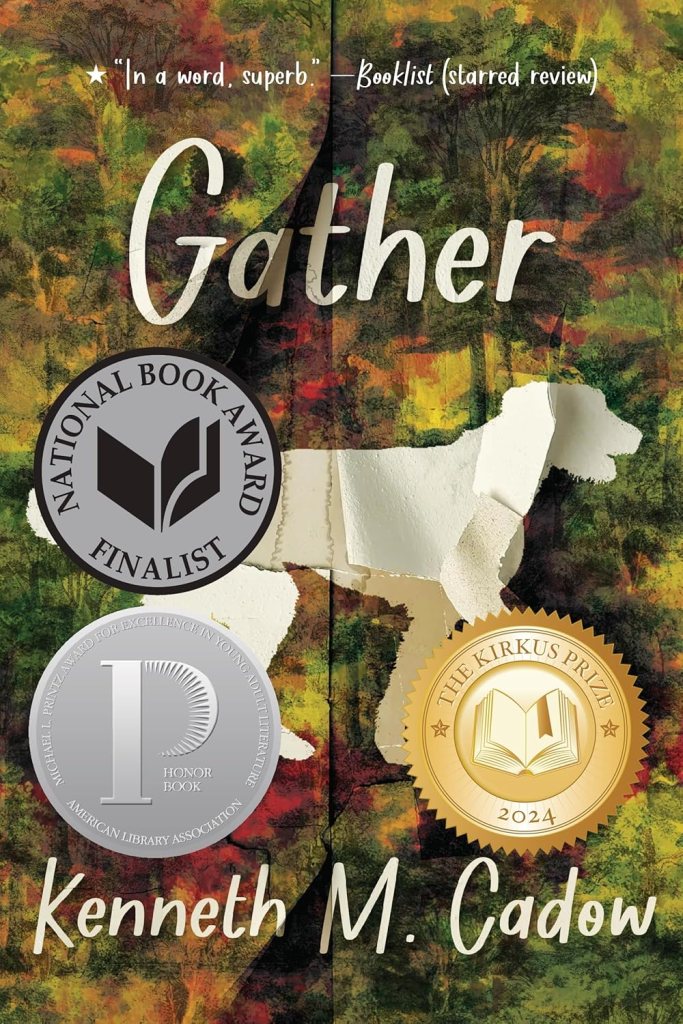
Justification: I chose to read Gather by Kenneth Cadow because I was hooked by the coming-of-age themes explained in a Goodreads synopsis, the paper mache-like style of the book cover, and, to a lesser extent, that I shared a similar name to the main character. It was a Kirkus Prize winner and a Michael L. Printz Honor Book.
Style and Language:
At first, I didn’t like the sentence structure or the word choice in the story. Many of the sentences felt long winded, with them including multiple ideas that seemed loosely connected to each other. Also, their consistent use of curse words and the frequency of Ian saying that a character “really pissed him off” came off as angsty and appearing more for shock value. These things made it a bit difficult to read through the chapters and get acclimated to the flow. However, as more was revealed in the story, this style of narration helped to show how he coped with the multiple stressors at school and at home. It became less noticeable in the story as I was able to get a better understanding of Ian’s voice and personality.
The POV is tied directly to Ian’s (his full name is Dorian, but he goes by Ian) thoughts which seem jumbled. The narration itself is reminiscent of a younger child telling a story as it seems to run on at times with long sentences, often having multiple main points in them. The narrator swears a lot for emphasis and to mention how a person’s words or actions “piss them off.” The book even spells god damn as “goddam.”
The content in each chapter bounces around from different points in time to give more context to what Ian is experiencing in the story. This time is used to introduce different characters, their history with Ian (good or bad), and explore his connection to his home in Vermont. Near the end of the book, there are less of these flashback moments as the readers are getting more caught up with the current day Ian.
Themes:
Characters:
Ian, the main protagonist, is a resourceful young man who believes that people throw things away too much without trying to fix it. As such, he tends to collect things that other people have thrown out and fixes it himself. Most of the stuff around his house is fixed by him and the items in the tool shed (kept by his grandfather – who passed away when Ian was younger around middle school).
Due to the situation with his father leaving and no longer financially supporting Ian and his mother, they have become more desperate. They are both looking for jobs that can support them, but his mother seems to be opposed to him getting a job to support them (at first). His mother hurt her back and has had trouble keeping a job since due to the injury. However, she is supportive of her son and his interests, even going so far as to spend almost all of her money on getting Ian basketball shoes.
Ian and his mother seemed to value independence over relying on other people. Ian’s father didn’t appear in the story often, but his character weighed heavily on how Ian and his mother acted and set up most of the main conflicts. Sylvia Pearson, a new transfer student, as well as the rest of the Pearson family came from a higher class and contrasts with the types of financial struggles that Ian and his mother face. Gather is the name of the dog that walks up to Ian and is later adopted into their household. A consistent gag in the narrative was that other characters kept trying to guess what dog breed he was.
Call the Name of the Night by Tama Mitsuboshi
Genre: Manga volume, Fantasy
Target Age Group: 8th grade+, 13 years old+
Plot Summary: Mira, a young girl with supernatural powers over darkness, is being treated by her doctor, Rei, to help her gain control over her abilities. However, will her own fears consume her and cause her to hurt other people, or will she be able to find peace with herself?
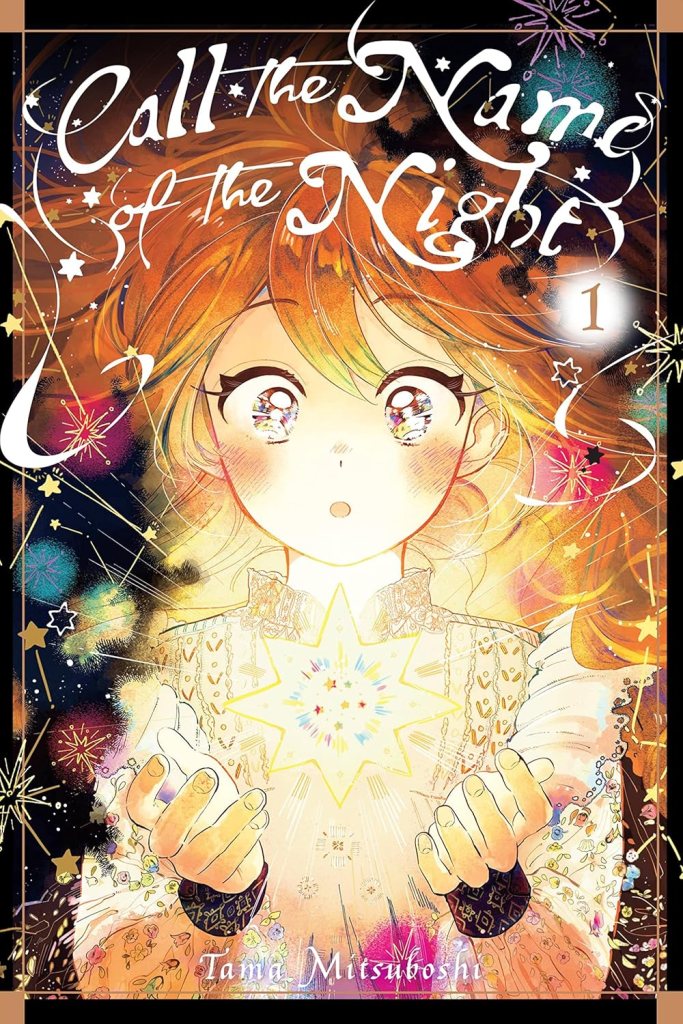
Justification: On the 2024 Great Graphic Novels for Teens book list on YALSA, this manga caught my interest from its art style (vaguely resembling a Studio Ghibli movie, in my eyes), colorful book cover, and its humor.
Illustrations:
The illustrations doesn’t go outside the realm of realism. The facial expressions and the physical movements of the characters, and the general motion of objects all mimic real-life. Their eyes are very expressive. They may not always reflect what the characters they’re looking at, but they do showcase how the characters are feeling in the moment. Akin to the idea that the eyes are a pathway to the soul.
When the pages on both the right and left side merge together, it usually transitions clearly by starting on a new page and it removes the boxes/grids.
Each chapter has its own single page that helps to introduce the themes/foreshadow what’s to come in the next chapter. It also includes a unique illustration that has no grid, includes a title for the chapter, and has at least one main character or object in them.The pages add visual sound effects to help show movement and the characters interacting with their environment. They are also all in black and white and have detailed shadings.
Themes:
One of the main themes in this manga is learning to accept yourself for who you are. Mira’s nature scares and seems to remove or hurt others. But, by accepting the dark/night which is a part of themselves, rather than rejecting it, they can better realize who they are. They still shine bright; by calling the night, they remember how bright they can shine.
The book also relies heavily on the theme of the stars and light. The absence of light brings forth dark or night in the typical day cycle. However, the dark doesn’t always have to be something to fear. It can be just as gentle as the light can be aggressive. You’re not always safe just because you feel more comfortable in the light.
Characters:
Mira is the main protagonist of the story. They have difficulty with controlling their powers and have moved to a special doctor, Rei Rigel, (whom Mira refers to as her “master”) to better treat her.
Mr. Cartos is a foil to the Mira’s master. He sees Mira as a test subject to learn more about a unique disease, to further science/magic research. As such, he manipulates events to where Mira loses control in order to better study her reactions.
A battle of approaches: Mira’s master (Rei Rigel) wants to treat Mira as a person and make them comfortable while Cartos sees this as an opportunity to learn. Cartos encourages facing your disease head on, while Mira’s master focused on distracting from the main issue to better help their mental health (encouraging restraint). Using the Howl’s moving castle example before, Mira’s master is like Howl while Cartos is like a combination of Howl’s teacher and the purple witch obsessed with taking his star heart.
Banned Book Club by Kim Hyun Sook
Genre: Autobiography/Biography
Target Age Group: Teen to young adults, 14+
Plot Summary: Banned Book Club follows the journey of a young woman, Hyun Sook, as they attend college in South Korea during the 1980s. As Sook learns more about their country’s history, they are forced to choose between ignoring what they’ve learned and continuing to be an average university student or protesting against their government’s attempts to censor their citizens.
Justification: I chose to review Banned Book Club because I enjoy reading memoirs that push beyond a simple autobiographical format and after seeing it multiple times at my local library. Officially recognized on ALA’s 2021 Best Graphic Novels for Teens list, I was interested in how the graphic novel combined multiple real accounts of the South Korean government in a fictional setting.
Illustrations:
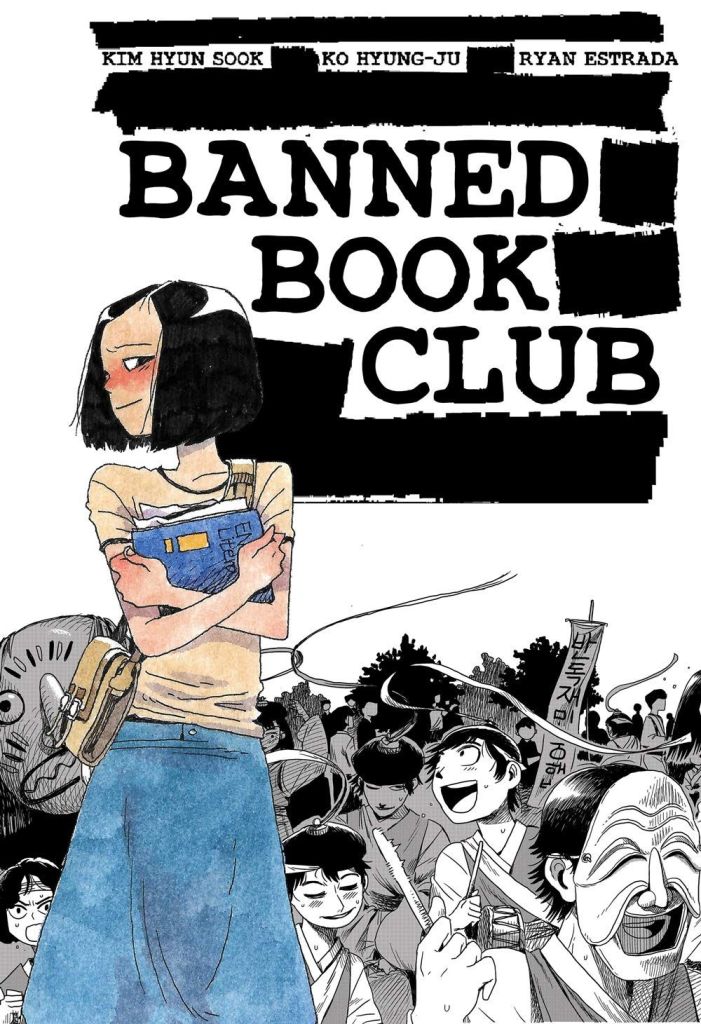
The illustrations have a unique mixture of manga and western graphic novel art style. The characters remain expressive through their facial expressions, body language, and sudden reactions while not bending the rules of physics/what is believable. The black and white artwork helps to enforce a more serious tone, despite some of the more cheerful or lighthearted moments between the Banned Book Club members.
Characters:
Gundo advocates for people to root for their country not their leaders if they’re angry about not being able to gather in the public spaces. He is focused on advocacy for work unions (potentially in a factory, but could also just be for unions in general).
Suji, who is a part of the feminist association and seems to have a violent temper against police authority, advocates for lower regulations for on-screen nudity. Potentially seeing it as something that shouldn’t be so taboo.
Yuni is the more serious of the group. They are also the one who apologizes for Hyun Sook not being told what the club was about fully. Yuni is an activist that realizes Hyun Sook was roped into something they didn’t fully understand and they didn’t know the full consequences of participating in the club.
Hyun Sook, the main character of the story, is focused on being a good student, adhering enough to what their parents want to not be chided or forced to leave schooling, and is not aware of the types of activist campaigns/protests around the college. They are afraid that by staying in the club, they will have everything taken away from them.
Agent Ok is a caring parent who treats protestors as if they are enemies of the state/country. His caring persona drops very quickly once he starts dealing with the Banned Book Club members.
He seems to take pleasure out of torturing/beating protestors suspected of North Korean sympathies or ideologies. Hoon, a member of the Banned Book Club, is the first person that is shown to be interrogated by Ok. He watches as Hoon is beaten by another officer and from his words and facial expressions we begin to take a look into Ok’s psychology. He seems to hate South Korean protestors and immediately assumes that they are connected to the North Korean leader, Kim Il Sung. Later on, when he finds out that Jihoo’s book was written by Kim Sung, he gets elated.
Setting:
The graphic novel begins in South Korea during the early 1980s. In South Korea, at this time, there was a large push by student-led demonstrations to resist and protest the authoritarian focused military and government. Having any sort of North Korean sympathies or ideas of an alternative type of government was seen as traitorous behavior.
Hyun Sook wants to attend college (Anjeon University), but their mother, who is the chef for their family run business, doesn’t see the point of a college education. The mother comes from a background where they needed to stay out of school to support her family. Also, the mother points out that college/school seems to be more about the protests and riots than learning nowadays. The father disagrees and helps the protagonist (his daughter) to apply and attend college.
References:
Cadow, K. (2023). Gather. Candlewick Press
Mitsuboshi, T. (2023). Call the name of the night (A. Haley, Trans.). Yen Press. (Original work published 2021 by Kadokawa Corporation)
Sook, K., and Estrada, R. (2020). Banned Book Club. (Hyung-Ju, K., Illus.). Iron Circus Comics
Sanderson, B. (2025). Tress of the Emerald Sea (M. Kramer, Narr.) [Audiobook]. Dragonsteel Entertainment.
Veen, J. (2025). Blood on her Tongue (E. Tucker, Narr.) [Audiobook]. Poisoned Pen Press

